Thursday, February 12, 2009

Happy Darwin Day!


As all (or many, or some, or none) of you may know, today is the 200th birthday of one of our most famous presidents, Abraham Lincoln. However, Lincoln is not the only famous person born today. It is also the 200th birthday of Charles Darwin. Yes, as amazing as it seems, these two men were born on the exact same day in the exact same year: February 12, 1809. So why is today Darwin Day, then, you ask, and not Lincoln Day? Well, for one, Lincoln already has a day, President's Day, set aside for honoring him. And, for another, this year marks not only the 200th anniversary of his birth, but also the 150th anniversary of his greatest work, On the Origin of Species by Means of Natural Selection, or the Preservation of Favoured Races in the Struggle for Life, more generally known as The Origin of Species.

The celebrations of Darwin's life and legacy that are happening all around the world today and over the course of this year (for more information, you can go to the official website) fill me with hope. Over the past few years, I have watched with horror and disgust as creationists and religious people of all stripes have tried to undermine the teaching of the facts of evolution to students in the public schools. As a student of science myself, and as someone who recognizes that society will get nowhere if it does not embrace the realities of the world and work to understand them instead of trying to bury them because they do not conform to ancient dogmas, I mourn for every child who grows up without an honest understanding of evolution. To see educators and scientists and laypeople all coming together to celebrate science and reason for once, and to do it around the figure of Charles Darwin, whose theories still remain controversial despite being absolutely true, is very inspiring.

And that is the most important thing to note about Darwin's Theory of Evolution. Unlike almost every other well-known scientist whose discoveries opened up a whole new field of study, Darwin's observations and conclusions about evolution and natural selection remain as true to reality today as they were in 1859. They have been enhanced, and modified slightly by the discovery of new evidence, specifically by the understanding of DNA as the source of genetic distinction and the mapping of genomes to determine the similarities and differences between all living organisms, but the discovery that all living organisms on this planet have evolved from other organisms, and continue to evolve through the method of natural selection, is a fact of the universe.

And what an amazing fact it is! To think that even human beings have changed over time, and are still changing, that what we are now is not all that our species will ever be, is mind-boggling. Add that to the idea that our intelligence and self-awareness, the things that we have always used to set ourselves apart from the animals, may not always be unique to us, and to recognize traits of intelligence and self-awareness in other animals is incredibly humbling. We owe the ability to see our world and ourselves as more connected and more ever-changing than we could have imagined to Charles Darwin, and if that is not something worth celebrating, then I don't know what is.

Happy Darwin Day!

Friday, January 30, 2009

Why I Am An Atheist - Part 3


The lightning strike came in the form of a 2006 BBC documentary called "The Root of All Evil?" that was written and presented by a man named Richard Dawkins. Dawkins has gained notoriety over the past few years as one of several highly-educated non-believers, sometimes derisively called the "New Atheists," who have spoken openly and passionately about the harm that religion and belief in God and the supernatural are doing to society. If you wish to watch the documentary yourself, I highly recommend it. It consists of two parts; The God Delusion and The Virus of Faith. More information on Richard Dawkins can be found at his website, Richarddawkins.net.

Everything within that documentary spoke to me in one way or another, but the majority of it was stuff that I had already recognized about religion, and I had also come to realize that the existence of religion and the existence or non-existence of God are not mutually inclusive. Just because there is religion doesn't mean that God exists, and just because religions are divisive or harmful or evil does not mean that God does not exist. But there was one point that was brought up in the documentary, so brief as to almost seem an afterthought, that struck me like a bolt of lightning from a clear blue sky: the idea that belief in the existence of God diminishes the awesome majesty of the world around us.

It was something I had never considered before. I was never a young-earth creationist or anything - I understand and accept evolution, the age of the Earth, the depth and complexity of the cosmos, and everything that science has found out about the world so far - but it had never occurred to me to question the belief that something out there bigger than us had to have been ultimately responsible for our existence, and that that something was God. Take away the assumption that the creation and evolution of human beings, of the world, and of the universe was in some part guided by an omnipotent being, and consider that instead it had all just come about by a myriad of natural processes that we do not yet know about or fully understand: it still blows my mind to think about it in those terms.

Inventing a deity to explain the complexity of the universe may seem like an easy way out, but it really raises more questions than it answers, especially when the definition of that deity requires that it exist outside of time and space and nature, everything we are capable of examining and understanding (this is the definition of super-natural: if it is outside of nature, how can we ever have a hope of examining or understanding it?). But stop to contemplate that the vast complexity of space and time around us is the result of nothing more than billions upon billions of natural processes, each one tiny but important, most of which we have not even imagined much less begun to understand, and it makes our world, our existence, and our ability to try and understand everything we see around us all the more amazing.

And the thing that makes it so amazing, at least to me, is the fact that it means that we are nothing special. If the natural forces that created the universe one tiny step at a time were able to create us, then intelligence is not something unique or impossible to understand. If it is a natural phenomenon, and not a God-given spark, then we may not be the only intelligent beings in the universe, or the only species on our own planet capable of being intelligent. And the realization that, even with our intelligence, we are no more special or unique than any other animal that has evolved physical and mental character traits that allow it to survive and manipulate the world around it totally changes your view of the world. Once I took God out of the equation, even for a moment, I realized that the world doesn't need him to explain its existence, and therefore neither did I.

I had discarded religion because there was no way of knowing who was right, and there were too many people telling me too many contradictory things about how the creator of the universe wanted me to live my life. I discarded worship of God when I realized that he could not be the all-knowing, all-powerful, all-loving deity that I had been raised to believe he was, a realization best described through the words of the Greek philosopher Epicurus:
“Is God willing to prevent evil, but not able?
Then he is not omnipotent.
Is he able, but not willing?
Then he is malevolent.
Is he both able and willing?
Then whence cometh evil?
Is he neither able nor willing?
Then why call him God?”

And I discarded belief in God entirely when I realized that the universe did not need such a deity in order to exist, and is in fact a more amazing and wondrous place without him. When I reached the end of the documentary, and heard Richard Dawkins speak so eloquently about how he, as an atheist, placed the highest value on this life, because it is the only one we have and we are infinitely lucky to have it, I realized that I was an atheist too.

It has taken a lot of reading, thinking, and refining of my own ideas about the world, life, and where I stand on issues of knowledge and belief, but the real reason why I am an atheist now, and will continue to be one for the foreseeable future, is because I no longer see any reason to believe in the existence of something for which there is no factual evidence. This hasn't diminished my view of the world in any way; in fact, finally discarding a belief in God made me a much happier person. I realized that the world is more complex and amazing than I could have imagined, I decided that any purpose I choose to make in life will be guided by my own hand, and I discovered that I am still the same good and decent person I always was, even without an all-seeing vindictive deity in the sky analyzing my every thought for human weakness. And I am also a much more complex person than the label of 'atheist' can cover. All I am as an atheist is a person who does not believe in the existence of God. But life is more than a series of labels, obviously, and in future posts I hope to move away from examples of what I am not and instead focus on who I am and how I see the world.

I would like to conclude this extremely long topic with two quotes by one of my favorite authors, and favorite atheists, the late Douglas Adams. I was surprised and overjoyed to find, when I discovered the writings of Richard Dawkins, that he and Douglas Adams were both great admirers of one another. I would ask that anyone who is a fan of Adams read the wonderful tribute to his life written by Dawkins; it appears at the end of The Salmon of Doubt, and you can also find it here, along with Dawkins' eulogy to Adams. I could probably fill a whole new post with my favorite Douglas Adams quotes about atheism, but these two quotes by Adams sum up my reasons for being an atheist in a way that I never could alone.

Isn't it enough to see that a garden is beautiful without having to believe that there are fairies at the bottom of it too?
-- Douglas Adams, from Last Chance To See

...imagine a puddle waking up one morning and thinking, 'This is an interesting world I find myself in, an interesting hole I find myself in, fits me rather neatly, doesn't it? In fact it fits me staggeringly well, must have been made to have me in it!' This is such a powerful idea that as the sun rises in the sky and the air heats up and as, gradually, the puddle gets smaller and smaller, it's still frantically hanging on to the notion that everything's going to be alright, because this world was meant to have him in it, was built to have him in it; so the moment he disappears catches him rather by surprise. I think this may be something we need to be on the watch out for.
-- From a speech given by Adams at Digital Biota 2. Later quoted in Richard Dawkin’s Eulogy for Douglas Adams.

Thursday, January 29, 2009

Why I Am An Atheist - Part 2

Okay, so tomorrow ended up being a very relative term when it came to the deadline for this post, but it's here now. Also, I ended up having way more thoughts than should be put in this post, so there will be a third part to all of this, which WILL be posted tomorrow. Anyway, where was I? Ah yes, I had just explained how specific events in my childhood had led me to question the nature of God and religion as it had been taught to me in church, at school, and at home. My mind was open to an understanding of religious faith, and I was not afraid to question my beliefs, but it took a long time for me to even consider questioning the existence of God or any other higher power. I realize here that saying that it took a "long time" may be misleading - long is a relative term when one is young. I had accepted that there were very few hard facts about religious belief by the time I was twelve, but it took me that many years again before coming to the conclusion that God himself did not exist. If I look back on that period of time from my fifties, it will probably seem like a very short span of time, but looking back on it from my twenties, as I am now, it has taken almost half my life to sort through and decide where I stood on one specific idea about the world. And it was both a long, slow process and a lighting bolt of revelation at the same time.

To be fair, most of my teenage years were spent not thinking very much either way about religion or the existence of God. I was still growing up within a family, a community, and a larger society that took the existence of God as a fact, so while I questioned the details of religion or aspects of God from time to time, and debated those details with others, the reality of a moderate religious childhood is that religion rarely touches many aspects of your life outside of Sunday mornings. I grew up with more religion than most because of my Catholic school upbringing, but once I entered public high school, it became almost a non-issue against the backdrop of my education and my social life. Looking back, I see a thousand tiny events that have influenced me in one way or another, but the big change did not come until I left home for the first time and moved to college.

College is the place, I am sure, where many children brought up in a religion begin to question their beliefs. Not only are they on their own in the world, without their parents looking over their shoulder any more, they are also being exposed to a whole new level and style of education that is not present within primary and secondary schooling. In college, in order to fully learn and understand one's chosen field, students are encouraged to ask questions, to do research, and to develop their own way of viewing and interacting with the world. They learn not only facts, but they learn how to add new knowledge and information to what we already know. In college, I was encouraged to develop my critical thinking skills, to understand why the things I was taught were true, and that asking questions about the world was the only way to find real answers. But that was not what changed everything, because I had already been willing to do all those things when examining religion.

What changed everything, my entire way of looking at the world, was the fact that I woke up one morning, less than a month after moving away from home for the first time, to watch the collapse of the Twin Towers in New York City. The events of September 11, 2001, turned my world upside down. I was away from home, in a big city without any family or close friends around, and I had just seen an act so evil that it was completely out of the realm of my understanding. I didn't know why it had happened, or who could have done such a thing, and I had to find answers. Delving into the investigation, and the realization that it had been committed by an extremist religious group for religiously-motivated reasons opened my eyes to an aspect of religious belief that I had never seen - or even knew existed.


I had prided myself on my understanding of different faiths. I had studied many other religions - I knew their similarities and differences to Christianity, their principle beliefs, and how they practiced and expressed their faith. Or at least I thought I did, until I was introduced to the idea of religious extremism. And not just Islamic extremism, but the extremism of all faiths. Before leaving home for college, I had very little exposure to the reality of events in the outside world. I did not have reliable access to the internet, I did not read newspapers or watch the news on television, and I was more or less oblivious to the amount of hatred and violence that went on in the world. When I went to college, I suddenly had free and ever-present access to information about the world, and the wake-up call that led me to start looking at that world with open eyes was only the beginning of the horror I felt when I saw that religious belief was more complex and more invasive than I had imagined.

Once again, I don't want you to get the impression that it was the evil I saw religious people doing that "pushed me away from God," because it wasn't. I recognized then, as I still do now, that people have done both great good and great evil in the name of religion. The same is true for many other philosophies. But recognizing that religion does drive people to do horrible things - to hate, to murder, to terrorize their fellow man - it has to make one question the all-good, all-knowing, all-loving God that in whose name those people hate, murder, and terrorize. Gaining an adult perspective on the world finally gave me the means to start asking the hard questions: If God is all-loving, then why is there evil in the world? Why do bad things happen to good people? Why are people of drastically differing faiths, or no faith at all, just as good or as bad as anyone else, if only God can show you how to live a good and moral life? And why do some people believe that committing obviously immoral acts are good if done in the name of religion?

The news media gave me a full view of everything that was going on in the world, and the internet gave me access to the entire world's opinion about every event, significant and trivial. I was exposed to the true diversity of life, of human experience, and I realized that the world was darker and more complex than I could have ever imagined. And as I slowly began to question everything I had thought to be self-evident, the lightning struck.

Tuesday, January 20, 2009

Why I Am An Atheist - Part 1

I had to think long and hard about what to put in this post, which is why it has been delayed. It is not easy for me to pick out the elements and events in my life that specifically led me to realize that the god I had believed in probably did not exist; when I examine everything, I find that my life is just one long continuum of events and experiences that has led to my current mindset, and each day I am adding new information that modifies and enhances my view of the world. This is going to be a long post, so I am breaking it into two parts for convenience. Part 1 will describe a few events in my childhood that made it possible for me two question the validity of religion and the existence of God, Part 2 will describe the events that led me as an adult to conclude that God probably does not exist.


I was born to a family of moderate Lutherans, but my childhood had more religious emphasis than many other moderate Christians because I went to a Catholic school for kindergarten through eighth grade. Fortunately, it was a fairly progressive Catholic school (only the eighth grade teacher and the principal were nuns) but we did have religion class every week and we did attend a children's Mass every Friday. Each class took turns sitting up at the front and leading the readings and the prayers, so at the age of six, as the only student in my kindergarten class who could read, I vividly remember standing up at the pulpit to give the readings every time our class led the Mass. I was introduced to religion in the way best-suited for childhood indoctrination; as a subject to be studied, understood, and taken as fact alongside math, science, history, reading, and writing. It never occurred to me to question the existence of God, or to even consider the fact that there may be people out in the world who heard the same things I did and did not believe it to be true, or that there were people who believed entirely different things, or did not believe at all. At least not at first. But there were two inevitable clashes coming that I can directly link to my questioning of the validity of religion and the existence of God.

The first was the fact that I was being raised in two religions. Every week, I was being taught the basics of Catholicism - their interpretation of the Bible, their rules and rituals - and every Sunday, I was being schooled in the Lutheran religion. And I was proud to be a Lutheran, to be a member of the church that first split away from Catholicism and dared to find a different way of interpreting the Bible. I imagine that you can see where this is going. I was learning about the way that Catholics interpreted the Bible, and I was constantly asking questions about why they saw it one way and Lutherans saw it another. And as I began to learn about the existence of other religions, and as I came to understand that even different Protestant religions had vastly different understandings of the Bible, I just couldn't stop asking why.

My favorite example of this: I learned during a Sunday school class on other religions that Catholics, Lutherans, and other Protestant religions all have different ways of interpreting the phrase, "Take, eat, this is my body. Take, eat, this is my blood" (I'm paraphrasing here). These are the words that Jesus said over the bread and wine at the Last Supper, and these are the words that most priests and pastors say over the bread and wine at the Eucharist when they consecrate it, or turn it into the body and blood of Christ. The Catholics believe that when the priest says these words over the bread and wine, it LITERALLY turns into the body and blood of Christ. They put their emphasis on "This is my body, this is my blood." Lutherans believe that the bread and wine turn into the body and blood of Christ while remaining bread and wine, but that the transformation does not occur until it has entered the person's body. They put their emphasis on the "Take, eat" and "Take, drink." All other Protestant religions, I was told, view the changing of the bread and wine as purely symbolic - it is a representation of Christ's sacrificial body and blood, but it is not literally transformed. One simple phrase, interpreted different ways, leads to three separate types of religion. And although it may seem to be a trivial difference, these differences of interpretation occur in one of the most vital expressions of the Christian religion. If you are of one religion, it is not acceptable for you to participate in the sacrament of the Eucharist of another religion because you have not gone through the training that allows you to fully understand the significance of the ritual. Wouldn't you think, if this expression of one's belief in and devotion to God was so important, that it would be easier to interpret?

Anyway, my opportunity to study other religions and my desire to understand why they did not all believe that same things, since it all seemed to start out so easy to understand, led me to constantly question why other people believed the things they did. This inevitably led to me questioning why I believed the things I did, something that I still do and will probably continue to do for the rest of my life. Though the ability to question why one believes the things she does does not make one an atheist, it certainly makes it hard to be religious, because eventually every religion has some things you are supposed to accept without question, and that wasn't something I was willing to do. But there was another event that started me on the path of questioning not only the validity of religion, but the existence of the God that so many religions claim exists.

When I was in the fifth grade, a very close friend of mine, a man named Denny Medill, committed suicide. The event in itself was a traumatic experience for me, but since I had experienced the death of friends and loved ones before, it did not cause me to question God in the way you may expect. I knew that people died, and went to heaven, and were in a better place, and that I would see them all again when I died. That was a fact of life, as far as I was concerned. But Denny's death put me at odds with a religious teaching that I was only just starting to learn about: the existence of hell.

My religious teachers were very savvy, and they knew that exposing a small child to the fullness of their ideas about hell right off the bat would be a traumatizing and cruel experience. So when I was just learning about religion, I believed that hell was a place that only the worst people in the entire world, like Hitler, went. I was convinced that hell had to be a fairly empty place, because no one could be so bad as to deserve to be punished for eternity. Except for Hitler. (I don't know why, but I once imagined that Hitler was the only person in hell. I think he was the only person that I could imagine had done something bad enough to deserve hell. I was, and still am, very optimistic when it comes to believing in the goodness of people.) But as I got older, the list of things that people could do, or not do, during their lives that would land them in hell grew longer, and longer, and longer. And Denny had not only committed suicide, but he had also been non-religious. A double-whammy. I was terrified at the thought that I would never see him again because of that. My parents tried to comfort me by telling me that God knew what he was thinking before he died, and that there was still a chance that he would go to Heaven, but all I heard was that there was a chance that he would not. He had been the nicest, funniest, happiest man I knew: I was having a hard enough time, at such a young age, wrapping my head around the question of why someone who seemed so happy and full of life would kill himself; the thought of him being punished for all eternity for a moment of terrible weakness was just too much for me to understand. So I did the only thing I could do in that situation: I rejected the idea of hell. I told myself that it did not exist, that the God I believed in would not allow such a thing to exist. But the problem with rejecting one aspect of a belief system is that it leaves you open to questioning and rejecting other aspects of it as well. And if the God that I believed in was suddenly not the same God that everyone else believed in, if he was now different because I refused to accept the existence of hell, then what did that say about the whole idea of God?

I will conclude this essay tomorrow with Part 2, when I will explain the events in my adult life that led me to the conclusion that there is probably no God.

Sunday, January 4, 2009

Atheism and Agnosticism: Defining the Discussion

Happy New Year, everyone! In an effort to get this blog off on the right foot, regular-posting-wise, I figured that my first post of the new year should be about defining some terms. Since I am planning on discussing my views on religion and atheism regularly, at least for the time being, I imagine that it will be helpful for all of you to understand what I mean when I use words like 'atheist' and 'agnostic.'


The first thing that is important to understand about the way that I, and many other atheists, use these terms is that we do not consider them to be mutually exclusive. "Atheism" means "without belief in a god or gods," and "agnosticism" means "without knowledge of god or gods." Given this distinction, many people who define themselves strictly as agnostics may find that they have never asked themselves where they fall on the theist/atheist divide.

The best way to understand this distinction between belief and knowledge is to recognize that there are differing degrees of atheism and agnosticism that people use to further define themselves: strong and weak. A strong atheist would most likely say, "I believe that there are no gods," while the weak atheist would say, "I do not believe that there are any gods." It may seem like a small distinction, but it is not, because it is the difference between saying that you refuse to believe that something exists and saying that it may exist but you are not willing to believe in it without some evidence. It may come as a surprise to some to find out that most atheists, even the most outspoken ones, consider themselves to be weak atheists. It may not come as a surprise to others, because most atheists value reason and an open mind and would not be willing to dismiss the possible existence of anything, even a god; they just will not act as if that god actually exists unless they have some tangible proof of its existence. I consider myself to be a weak atheist for this reason: I am not going to close my mind to the possibility of the existence of a god or gods, but I see no reason to believe or act as if they exist until I have some evidence that they do.

There are also strong and weak definitions of agnosticism, allowing us to further clarify the distinction between knowledge and belief - a distinction that I consider to be vital in a world that seems to enjoy blurring the lines at every turn. A strong agnostic says, "I do not know whether or not gods exist, but neither do you," while a weak agnostic says, "I do not know whether gods exist, but someone might." Some theists would probably see themselves as agnostics under this definition: having faith in something makes it completely possible to believe that a god exists while admitting that you don't actually have any specific knowledge or evidence to support that belief. Granted, very few people would ever concede to believing in something with absolutely no reason for their beliefs, but it is possible, on a personal level, to believe in something with no real proof of its existence. Though I did not realize it at the time, I was an agnostic theist for many years before I finally became an agnostic atheist, but that's an explanation better left for the next post.

I consider myself to be a weak atheist, but a strong agnostic. I will not discount the possible existence of an entity containing the characteristics of a deity, but I will not believe in one without evidence, and I do not think that anyone currently has any knowledge, scientific or otherwise, that could bring us any closer to discovering the existence of such an entity. But the great thing about this position is that it allows my beliefs to be malleable while giving me a position from which to critically examine the claims of knowledge that others bring me, because I will not accept claims of knowledge (since I do not think anyone has such knowledge) without strong, testable, scientific evidence.

I hope this has not completely confused everyone reading it, but if it has, I invite you to please ask questions in the comments, and I will do my best to clarify any points that may not be clear. I would also like to state that, while I have found these definitions to be a good explanation of my position, and that of many of the atheists that I read and communicate with, I do realize that not everyone recognizes these same definitions, so it always helps to ask others what they mean when they define themselves as a theist, atheist, or agnostic before engaging in a discussion.

That being said, though, if you consider yourself to be an agnostic, but not an atheist or a theist, I would ask you to think long and hard about whether or not you actually believe in the existence of a deity. It's fine to admit not knowing something, but if that lack of knowledge means that you do not believe in a deity, it is important to realize that that makes you an atheist by the standard definition of the word. It seems to me that a lot of people simply use the word "agnostic" to describe themselves because they see the word "atheist" as a pejorative. If more people recognized the distinction between knowledge and belief and chose to recognize that they are atheists if they do not believe in a deity, the true definition of the word would begin to overtake the pejorative definition, allowing us to have more open discussions between believers and non-believers, which is all that most atheists, myself included, really want.

Thursday, December 18, 2008

Reconciling Christmas Stories

So after looking over the list of ideas for posts that I have come up with over the past month, I have realized that most of my posts, at least initially, will be about my views on the world and how they have changed, or not, since I became an atheist. That being the case, I will be making several posts in the next few weeks explaining my views on atheism and what led me to stop believing in God. However, there is a certain holiday fast approaching, and I would be remiss if I didn't at least comment on my personal thoughts and feelings about Christmas.


I love Christmas. It has always been my favorite holiday. When I was younger, I used to spend months deciding on the perfect gifts to give everyone in my family, and now my husband and I spend the week before Christmas making homemade cookies and candy to give to everyone we know. I love getting out the Christmas decorations and putting the ornaments on the tree (even though the one I have right now is only a foot tall) and I love listening and singing along to all my favorite Christmas carols. Christmas is a chance to spend time with family, and an opportunity to show the people I love just how much they mean to me. But for the last couple of years, I've felt really uneasy about Christmas, and I think it has something to do with the fact that my favorite Christmas song is "Do You Hear What I Hear."

It is not that I have any problem with the religious overtones of Christmas, because it has evolved into a holiday that everyone can enjoy, no matter what their religious beliefs. I have not met anyone, religious, non-religious, or atheist who does not love to celebrate *something* during the holiday season. As the image above indicates, there are many parallels that can be drawn between the religious figure of Jesus, whose birth is celebrated at Christmas, and the secular figure of Santa. And therein lies the difficulty that I have been struggling with for the last several years, ever since I became an atheist. You see, I was raised to believe that one of those Christmas figures was just a nice myth that inspired people to be good and kind to one another, and that the other Christmas figure was a real person whose story was absolutely 100% true. And I bet you can guess which one was which.

It comes as no surprise to me that I am having a hard time demoting the story of Jesus from fact to myth. After all, it took me many years of suspecting that Santa Claus was actually my parents before I finally had to admit that he wasn't real, and it has taken me many years of study and personal reflection to come to the conclusion that God isn't real either. But every year at Christmas, when I hear my favorite Christmas song, I remember how much it meant to me to believe that there was a supernatural being who would "bring us goodness and light." Santa never brought anything but toys, which really paled in comparison to peace on Earth and goodwill to all men. It hasn't been easy to demote something that wonderful from reality to fantasy.

Of course, every year it gets a little easier to see the story of Jesus as just another myth, and Christmas as just a wonderful holiday that inspires people to give of themselves to one another, so I'm not about to dismiss the Jesus part of the holiday altogether. Trying to ignore the Christian element of Christmas would cut out so many of the things that I love about it, and so many of the icons that make Christmas what it is. But it is also a constant reminder that letting go of long-held beliefs is not an easy thing to do. So now, when I listen to my favorite Christmas song, I remember that there is nothing wrong with the ideas that the story of Jesus inspires - that we should be kind to one another, give to the less fortunate, and do our best to make the world a better place. But there is one word that I substitute in the last verse of the song, because I would rather *work* for peace.

Happy Holidays, Merry Christmas, and have a Joyous New Year!

Lyrics to "Do You Hear What I Hear"

Said the night wind to the little lamb
Do you see what I see
Way up in the sky little lamb
Do you see what I see
A star, a star
Dancing in the night
With a tail as big as a kite

Said the little lamb to the shepherd boy
Do you hear what I hear
Ringing through the sky shepherd boy
Do you hear what I hear
A song, a song
High above the tree
With a voice as big as the sea

Said the shepherd boy to the mighty king
Do you know what I know
In your palace wall mighty king
Do you know what I know
A child, a child
Shivers in the cold
Let us bring him silver and gold

Said the king to the people everywhere
Listen to what I say
Pray for peace people everywhere
Listen to what I say
The child, the child
Sleeping in the night
He will bring us goodness and light

Friday, December 5, 2008

So About This Blogging Thing...

Where does the time go, anyway? It's been two months since I promised myself that I would blog more often, and suddenly I look up and it's been over a month since my last post! I could blame my job and the holidays and the annoying muse of fiction deciding to camp out in my brain, but the truth is that I have always been a horrible procrastinator. No one believes this about me, but it's true. Yet somehow, I always manage to accomplish what I want to accomplish, and I am trying really hard to do something with this blog.

I have some post ideas, which I will start working through next week, but a little motivation is always helpful. So, if you happen to be reading this blog, tell me! That's what comments are for, and knowing that even one person out there is reading what I write will be a great motivator. Also, if you have any ideas for topics or things that you would like my opinion on, I'd be glad to address them in future posts. I'm still trying to find out where I am going with this blog, so I am happy to write about anything and everything.

On that note, I would like to leave you with an amazing piece of reporting on the Mumbai terrorist attacks from, surprise surprise, The Daily Show. If more news organizations could cut through the bullshit and explain events with this much clarity, maybe I would watch them too. Enjoy!

Saturday, November 1, 2008

Cautiously Optimistic


With just a few days to go before the election, I am proud to say that I voted today. I filled out my absentee ballot and turned it in. I am also proud to say that I am, for the first time in a long time, feeling cautiously optimistic about the outcome of this particular election.

I turned 18 just a few weeks before the 2000 presidential election, and I was so excited to cast my ballot and take part in the political process. I followed the election closely, and made an informed decision, then sat back and watched the democratic process crumble before my eyes. For four years I seethed under the governance of a president that I did not vote for and that was not elected by the people, only to see him get elected by the people the second time around, thanks to a lackluster opposing candidate who did not stand up for himself and did not know how to inspire people. At the start of this election cycle, I found that I had grown cynical. My voice had not been heard before, and the party in which I placed my trust seemed weak and ineffective, unable to stand up to a bullying opponent who had been able to convince so many people to go against their own best interests for as long as I had been paying attention to politics.

But somehow, this election ended up being different. The Democrats finally managed to field a young, inspiring candidate who was not willing to back down in the face of mudslinging and personal attacks. I watched as the Democratic convention came to my home town, as the state that I lived in became a major swing state after voting Republican for so long, and as friends and family members finally were willing to discuss politics in a positive light. Obama's messages of hope and change do not only apply to what he promises to bring to the Presidency, they apply to his campaign, and to what he has done for the Democratic party and the way that people view and talk about the political process.

I am still only cautiously optimistic in regards to the outcome on Election Day, however, because I have experienced nothing but disappointment so far. I am sure that many other young people my age feel the same way. The pride I felt participating in my first presidential election was shattered when the decision was made not by the people but by the Supreme Court, and my faith in Americans to make good choices was dashed in my second presidential election in 2004. To make matters worse, the Colorado ballot is proposing an Amendment this year, the first in the nation, that would legally define a human being as a "person" from the moment of conception, which, due to the highly generalized wording of the amendment, would make abortions and most forms of birth control illegal in my home state. This concerns me greatly because our state very easily passed an amendment banning gay marriage several years ago, and with the lack of avertisement for the current amendment, I am very much afraid that it will pass without much resistance and really screw up people's lives. Additionally, as an atheist, I often feel disenfranchised by a political system that loves to use us as boogeymen and paint us as evil, immoral, and unAmerican. I don't know if any of that will change any time soon, but I am doing my best, in my own small way, to stand up and make my voice heard.

Sunday, October 12, 2008

A Sad, Sad Day for the Atheist Blogosphere

After not having posted on this blog for a very long time, it is with a heavy heart that I return to posting with news that saddens me greatly. One of my favorite blogs, Possummomma, has gone dark after some very serious harassment of her and her family following what I can only summarize as a malicious case of mistaken identity. Since I am not privy to specific details, being only a reader of her blog, I will not endeavor to explain much more, but details about the incident can be found at The Calladus Blog, and at Berlzebub's Inferno.

So why is this so important to me, you may ask? Well, to put it simply, I was not always an atheist. I was raised religious, and only came to atheism in my 20s while at college. Now, I have a wonderful husband who is also an atheist, and I know that some day we will want to have children and raise a family. But when I look back at my personal experiences of childhood, and when I look to the adult role-models in my life that I would reach out for advice about raising children when the time comes, I find myself surrounded by religion. It is a hard thing to escape. Being an atheist, how do I explain death to my children when I was raised to believe in Heaven? How do I raise them to be moral and kind and caring and generous without relying on the Ten Commandments or the stories of Jesus? The thought of trying to raise children without ever reverting back to the moral instruction I received by way of religion used to terrify me.

Possummomma's blog changed all that. Her frequent posts about raising a non-religious family, despite her religious upbringing and recent deconversion, were truly inspiring. Her stories and photos showed a family that was happy, stable, kind, and loving, children who were smart and independent and thought for themselves, and parents who, despite many personal hardships, were able to put the really important things first and get through both the good times and the bad without religion. I admired her for her courage in putting so much of her personal life online, despite the fact that she attracted the worst sort of trolls because of it. Hers was the first blog that I ever chose to comment on, and it was her blog that inspired me to start one of my own.

And now, her blog has gone silent. And it makes me angry. Angry that people can be so pessimistic and suspicious that they would take any act of kindness and charity by people towards someone they had only met online and assume that the person receiving the charity has to be duping those who would wish to support them. Angry that a person who is brave enough to show the world that you can raise an amazing family without the crutch of religion would draw the ire of so many people who think the worst about atheists without even getting to know one. And it makes me angry to see the very worst aspects of human nature lash out and cause so much pain to people who are only trying to embody the best aspects of human nature (I am speaking about both PMomma and her supporters here).

But mostly, the silencing of PMomma has just made me sad. I find the Internet to be such an amazing place because it makes it possible to connect with people that you would never get a chance to know otherwise. PMomma is an amazing person, and she has become one of my role-models. I have so much to thank her for, and I am sorry that I never really got a chance to tell her so myself. Though this blog post has been a chance for me to vent my feelings on an occurrence that has greatly affected me, I am also using it as a call for personal action. I started this blog because of Possummomma, because I was so inspired by her frank, unapolagetic sharing of a family life without religion. She is one of the few that I have found that are willing to put their life up for scrutiny and say "I'm really just like you. I may be part of a despised minority, but I am your next door neighbor, your friend, your family member." If more people, more atheists were willing to put their lives as ordinary people on display, then maybe the people who doubt the existence of happy, ordinary, moral atheists would not be able to attack so easily.

So, this is my call to action. I am going to stand up here and now and say this: I am an average, ordinary person. I am happy with my life, I have a wonderful marriage, and I have the same plans and concerns about the future as any other ordinary person. I am also an atheist. I am the girl next door. I am your sister, I am your daughter, I am your friend. And I am an atheist. Doubt me if you must, but that does not change the fact that I know who I am, and that, from now on, I am going to own it, be proud of it, and tell everyone that I know about it too.

Sunday, March 9, 2008

Humanist Symposium #16


The latest Humanist Symposium is up at Glittering Muse! I encourage you to check it out. I found the introductory essay especially moving and insightful. My favorite article in this Symposium is the article on abortion. Jeffrey Stingerstein of Disillusioned Words has an amazing and provocative piece on the grey areas surrounding the pro-choice, pro-life debate, putting into words my exact thoughts on the issue that the debate on abortion is not as simple as the politicians and the activists on both sides make it seem.

I also really enjoyed the two articles on free will, specifically because I have been thinking a lot about human intelligence and what it means for us as compared to other animals now that I no longer believe in the concept of a "soul" that makes human beings unique. I hope to post my own thoughts on this idea soon.

The next Symposium will be up at Mind on Fire on March 30th. Hope to see you there!

Wednesday, March 5, 2008

Why We Need Each Other

So, today I added a list of my favorite atheist blogs to the sidebar of this blog. When I first started writing here, I was planning on keeping the atheist angle low-key, but an experience I had this weekend changed my mind. I have decided that, more than ever, it is important that I express my views on atheism and add my voice to the atheist blogosphere, because we atheists need all the publicity we can get.

The incident in question occurred when I brought up this article in the company of a group of friends on Sunday night. A brief explanation is in order: I am very close with this particular group of friends. We have known each other for many years and I have always found them to be a very open and understanding group of people. However, one of the few things that I do not know about any of them are their specific thoughts or feelings on religion. I know that some of them are nominally religious, most of them seem to be fairly indifferent to religion, and I am pretty sure that non of them are extraordinarily fundamentalist or anything, but I'm not really sure. Religion just never comes up in any of our discussions. I brought up the article that I linked to above because they all had lived in Boulder at one time or another, and I wanted their opinions on whether they thought it was the "smartest city in America." I also found it funny that the author of the article called Boulder the "most delusional" city, a statement that I tend to agree with, so I mentioned that part of the article as well, which then required me to explain to them why the author would have said that about Boulder.

To summarize, the article describes a situation in which an organization known as the Boulder Atheists set up a booth at a local community festival, and in order to get noticed by the milling crowds of people, they gave out free bottles of water. While they were noticed and thanked by some people for providing such a wonderful service on a hot day, there were some people who refused to take the water because the people who were giving it out were atheists. I thought it was pretty silly that people living in a city like Boulder, which is full of a healthy mix of rich conservatives and free-spirited new-age hippies and seems to be fairly accepting of everyone, would have such a negative reaction towards a group of atheists. But, unfortunately, I didn't have to wait long to experience my first direct run-in with the way that people who don't specifically view themselves as atheists think about those who do.

I didn't even get the chance to finish summarizing the article before my friends started making fun of atheists. "There are organizations for atheists? What do they do, get together and talk about what they don't believe in? *snicker*" "It takes just as much faith to say you don't believe in God as it does to say you do." "Atheists are all just agnostics with a chip on their shoulder." I was stunned and deeply hurt. I was expecting my friends to agree with me that it was dumb to not take free water from a group of people just because they were atheists, and here they were displaying the exact same prejudices as the people in the park. I kept my cool and tried to refute their arguments, telling them that most atheists don't believe in god because of a lack of evidence, they don't generally say "There is NO god." I explained to them that the word agnostic was a description of the strength of someone's atheism or theism, not a valid position on the existence or non-existence of a deity in and of itself. And I explained that groups of atheists generally exist in response to the rising voice of religious conservatism in this country, so they are there for support against religious encroachment on their rights, not to "talk about what they don't believe in." But the one thing that I couldn't bring myself to say (to my deep shame) was that I was an atheist and very happy to be one.

I have been reading blogs about atheism for a long time trying to prepare myself for a confrontation like this, but I expected it to come from members of my extended family, who are all very religious and whose opinion about me and my life choices matters to me not one bit. I never expected it to come from my friends, who were people that I thought understood me and whose opinion of me matters to me quite a lot. It hurt me even more because I'm pretty sure that they didn't know that their ridicule hurt me as badly as it did, but I couldn't bring myself to tell them. But there was a silver lining to this depressing incident. I found myself being supremely grateful to the atheist blogosphere, even more grateful than I was before this happened, because I realized that they serve a far greater purpose in my life than I could have imagined.

Up until this point, I have always felt a little silly reading so many atheist blogs. My husband is also an atheist, but he doesn't read any overtly atheist blogs because religion was never as big a part of his life as it used to be in mine. I had always thought that feeling the need to read so much about atheism when I wasn't surrounded by extreme religiosity was a sign of weakness in my decision to stop believing in god, and I kept hoping that a time would come when I was strong enough in my convictions and arguments for being an atheist that I wouldn't need the support of people I had never met before any more. Now, though, I hope that time never comes. I have seen that even the minds of the moderately to agnostically religious have been poisoned against the word "atheist." I see that the greatest challenge I will face as an atheist is not standing up in the face of people whose minds I don't expect to change, but standing up to people whose opinion of me actually matters to me. I have seen that even though I know all the arguments, the hardest part is saying "I think," instead of "Atheists think."

So, Ebonmuse, Possummomma, Hemant Mehta, Dale McGowan, Chanson, Greta Christina, Ed Brayton, PZ Myers, and all the other atheist bloggers out there whom I have yet to discover, I want to thank you. You guys are my support group, my daily reminder that friends can have many faces and that I am not alone in my need to surround myself with like-minded people, even if it's only in a virtual space. I am a quiet person, but some day I may leave a comment on your blog, or listen to you speak at a conference, and your influence on the world and mine will grow a little larger. It is true that the only thing that brings atheists together is something we all lack, but when religion has the ability to have such a great impact on our lives, and on the lives of people we care about, we owe it to everyone to organize and make ourselves heard, no matter how isolated we as individuals may feel.

Monday, February 18, 2008

The Humanist Symposium

I love reading blog carnivals. For those of you who don't know, a blog carnival is a serial post on a certain topic that showcases articles from multiple bloggers. There are blog carnivals on every topic you could possibly imagine, but the one that I have followed every three weeks since its inception is The Humanist Symposium. I post this now because the #15th Humanist Symposium is the first one to occur since I started this blog, but I will be posting the location of each one every three weeks when they are published. So, to reiterate, the 15th Humanist Symposium is now up at Cafe Philos.


So, why post this at all, aside from wanting to share the work of some amazing and talented writers? Well, the primary purpose of this blog is to air my thoughts on things that are important to my world view, and standing at the forefront of that world view at this moment is my position on religion and where it stands in the "quest for the meaning of life." Though this may not be well-known to anyone currently reading this blog, I decided several years ago that I was an atheist - which means that I weighed all my observations about the world with everything I had been taught about the idea of God as the creator of it all, and decided that there was no longer any reason for me to believe in something when I have no proof that it exists. That is the simple explanation, which I will expound upon at a later date.

However, after doing a lot of reading and self-evaluation of my thoughts and feelings with regards to being an atheist, I decided that it was not the label that I wanted to apply to myself when someone asked me what I believed in. To be an atheist is to not believe in something, and I am an atheist in the same way that I am a a-Santa-ist, an a-fairy-ist, and an a-Easter Bunny-ist. Not believing in something is not the best foundation for one's outlook on life, nor is it a good way to describe one's self when asked what one does believe in.

So I eventually came to the conclusion that I was a secular humanist - I believe that this life I have on Earth is all I've got, and that the same is true for everyone else, so I want to work every day to make the lives of everyone I meet (and those that I don't) a little better with my actions and my presence. As a humanist, I hold the care of my fellow humans above all else, but it is a secular humanism because I do not feel this way as a result of any religion or a belief in any deity. I wish I could explain it better, but I am still having difficulty expressing my thoughts and feelings about this significant change in my life.

That's where the Symposium comes in. It was started by my favorite atheist blogger, Ebonmuse, over at his blog, Daylight Atheism, and has been going strong since April of last year. The wonderful bloggers who contribute to the Symposium every three weeks express their thoughts and feelings about what it means to be an atheist and a secular humanist better than I ever could, so I will continue to follow and advertise this excellent Symposium now that I have a blog of my own.

Thursday, February 14, 2008

Baby Pictures! (sort of)

OK, so, as a shameless excuse to finally let people know that I have a blog, I give you... more new rat photos! (I promise this blog is about more than rats, really)


Aren't they adorable!


Myst the eternally curious


I still can't believe how tiny Pepper is!


I'm ready for my close-up


Look at those big dumbo ears


The best of friends


OK, that's all for now. I'll try and think of something more interesting to post about tomorrow.

The Year of the Rat 2 - Meet the Family!

So this post is a little late in coming from my previous post, but since no one reads this blog yet anyway, I guess that's not such a big deal. Anyway... in the second post in my ongoing series about the amazing rat, I would like to introduce you to the rats that I have in my life. This post is fitting because we just added two new members to our family this past Saturday. So, without further ado, it's time to meet the family.

Maya
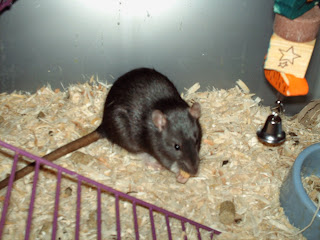
Maya is currently our oldest rat, and she is almost 2 and a half years old. She is a black Berkshire rat, which means that she has black coloring over her back, but has white coloring on her belly and paws, and the tip of her tail is white. She was the first rat we ever got from Camarattery, the rat breeder that we get all our rats from now, and she has been a pleasure and a joy. She is a very active rat: she runs on the wheel in her cage almost constantly when she is awake (and she is the only rat we've had so far that has run on the wheel), and she loves to try and run off into our apartment to explore whenever she is let out to play. She was the first rat to discover that she could easily jump or fall off most of the surfaces in our house (tables, chairs, desks, the couch) and not get hurt, and has used this cunning escape mechanism to get away from us at every opportunity. Fortunately, she is also very trusting and has an insatiable appatite for treats, so she is always easily lured back into her cage again.

Cas
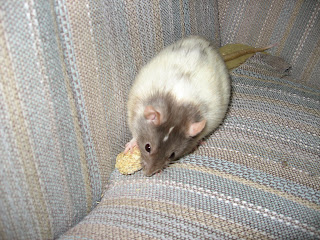
Cas was the baby of our little family until last weekend. She is around one year old. We adopted her from our rat breeder at six months old, so she had already been given the name "Castaway," which we shorted to "Cas" (pronounced KAZ). She is an odd rat, more nearsighted than most (and all rats are so nearsighted as to be almost blind anyway), a bit aggressive and clumsy around her cage mates, and a complete homebody. She hates exploring, or even coming out of her cage. She is a Lilac Merle Variegated Down Under rat, which describes the color of her fur, that lovely light brown, and the fact that she has that color on her head and shoulders, with a white blaze on her forehead, spots of color running down her back, and spots of color on her belly. Rat coloration terms can get very technical.
Cas is a wonderfully calm rat when being handled by people. She will let you hold her without squirming, and she loves having her belly tickled. Though she has always been a little odd, we love her dearly, and her quirks are a further example of the depth and complexity of rat personality.

Myst

The first of our two new babies, Myst is an 8-week old American Blue rat. She has perfect color, and I have totally fallen for the "blue" color, that lovely silver-gray that gave me the inspiration for her name (even though I spelled it in honor of my favorite video game). Though we haven't known her for very long, and she has not yet been introduced to our older rats, I can tell that Myst is going to be as friendly and outgoing as Maya. She is as full of energy as any young rat could be, she loves to be the center of attention, and she is constantly peeking curiously out of her cage at every new sound. She is also very sweet, and already licks my hand whenever I open the cage door to say hello. I can't wait to watch her grow up.

Pepper
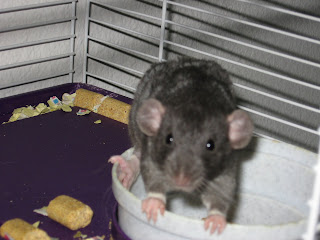
The true baby of the family is Pepper, our other new arrival. She is only six weeks old, and is still so tiny that she fits entirely in the palm of my hand. She is a black Berkshire Dumbo Rex rat, which means she is the same color and has markings similar to Maya, but she has "dumbo" ears that stick out straight from the sides of her head instead of pointing up, and she has curly fur and whiskers rather than smooth. She is also outgoing and rambunctious, but easily frightened and skittish as she is still so very young. She is also an attention-grabber, who will push her nose in wherever Myst is, and even tries to push or pull the larger rat out of the way when she feels she isn't getting her fair share. She and Myst are great companions already, which bodes well for their introduction to Maya and Cas in several weeks, after the mandatory quarantine period is up.

IN MEMORIUM

Maya, Cas, Myst, and Pepper are our current rat family, but they are not the first rats we have had, nor will they be the last. Though rats make wonderful pets, the sad fact is that they do not live very long, usually around 3 to 5 years, though a good diet and healthy living can extend that period. As such, we have had four other wonderful rat friends that are no longer around.

Rosco

Rosco was our very first rat. We rescued her, unintentionally, from a pet store that sold rats for food. This meant that she had never been socialized, had never been around people, and we had no way of knowing how old or healthy she was when we got her. Despite that fact, she lived with us for over three years, finally dying this past November of old age and cancer. Rosco was not very rambunctious or social, but she loved to explore and spend time running around on the couch or our desks while my husband and I watched TV or did homework or played video games. She was a great friend, and we were very sad to see her go.

Nick

Nick (short for Nicodemus - like most new rat owners, we named our first two for the rats of Nimh) was Rosco's first cage mate, we bought them both at that pet store and brought them home together. Nick and Rosco were my very first pets (besides fish), so when she got sick and died within a week, I was understandably devastated. All rats suffer from a respiratory ailment known as mycoplasma, and when they get sick or their immune systems weaken, this ailment becomes a full-blown disease that can kill them very quickly. We took Nick to the vet and got her antibiotics, but she was just too small and sick to last very long. Though we didn't know her for long, she will always hold a special place as one of our very first rats.

Pip

Pip was our second attempt at purchasing a pet store rat, this time from a major chain pet store that actually sold rats as pets, not as food. He was also our only male rat, as we thought that breeding him and Rosco and having a cage of male rats and one of female rats would be better than buying just one rat at a time. Unfortunately, he and Rosco never even got to meet, as he got sick just like Nick and lasted only two weeks, despite visits to the vet and antibiotics as well. After more experience with rats, we believe that Pip was too young to have been taken away from his mother, and that the stress of a new environment on such a tiny rat was what killed him. After he died, we decided to look into rat breeders, which led us to the wonderful breeder that we get all our rats from today.

Callie

Callie came to us from a friend who was being deployed by the Navy and couldn't take his pet rat along. We have no idea how old she was, but she was definitely the biggest rat we have ever had. She was also a sweetheart, calm and sedate, and she would grab your hand and lick it forever if you let her. We got her around the same time as Maya, so she, Maya, and Rosco were our first rat family until she died of unknown causes (probably an age-related stroke) a year and a half later. She was a great matron to our younger rats, and will always be remembered for her caring ways and adorable face.

And that's our family, past and present. In my next installment, though I will try to write about something other than rats before then, I will write about why rats are such good pets, as well as some of the things that you should know about them before choosing a rat as a pet. Until next time... a bit of trivia:

A group of rats is called a "mischief." And believe me, it is fitting.

Tuesday, February 12, 2008

Happy Darwin Day!


Today is Charles Darwin's birthday, so it's only fitting that we acknowledge the man who started us on the path to realizing exactly how we got to where we are today: evolution and natural selection. The images here were submitted as e-card designs to RichardDawkins.net in honor of the day. And, so as not to forget that he shares this auspicious birthday with another great man, I leave you with this card as well.


Celebrate knowledge, freedom, and the wonder of life today!

Thursday, February 7, 2008

The Year of the Rat

In recognition of the Chinese New Year, my next few posts are going to be all about rats. The rat is the first of the twelve animals of the Chinese zodiac, and people born in the year of the rat are supposed to possess the qualities of creativity, honesty, generosity, ambition, a quick temper and wastefulness. I was not born in the year of the rat, but I find it fascinating that the Chinese, as well as other Eastern cultures, hold the rat in such high regard when it has been thoroughly reviled in most Western cultures. Because the truth of the matter is that there is much more to the rat than their depiction as filthy, thieving, disease-carrying pests.

I could almost write a book on all the things that I find fascinating about rats, but most of that information is written about elsewhere. Instead, I will simply share what I find to be a few of the most amazing facts about rats:

1. Rats Laugh

Despite what people see in movies and TV shows, rats do not run around everywhere squeaking. The only time that rats make noises audible to the human ear is when they are angry or in pain. Normal rat communication takes place in the ultrasonic range, and they are not extremely vocal creatures. However, using special equipment, scientists discovered that rats make short, high-pitched "chirping" noises during playful social interactions with other rats or with people. They also found that rats are ticklish in the same way that people are ticklish; they have sensitive areas on their skin that generate more laughter than others. The playfulness, and the laughter that accompanies it is seen more among younger rats, and the tendency to laugh and play declines as rats age, indicating that it is a social construction meant to stimulate joy and good feelings among groups of young rats, much in the same way that children laugh when playing with one another.


2. Rats are Highly Intelligent and Social Animals

Pet rats have been kept since the 19th century, when professional rat-catchers would keep some of the rats they caught for exhibition or fights. When they started breeding the rats, they began to realize that rats were highly intelligent and trainable, so they started selling them as pets. Through years of selective breeding, people eventually bred the domesticated "fancy rat" away from the common sewer rat, but the similarities remain. Rats are social animals who require the company of other rats for health and friendship. They engage in play, mutual grooming, and a complex social hierarchy that dictates their interactions with one another.

In the wild, rats are colony animals that work together to find food, protect their homes, and defend against predators, chief of which is man. However, human beings have to fight constantly to stay one step ahead of the rat. Rats communicate with one another through complex scent trails - a single drop of scent can tell another rat everything about the one that left it, from their age and health to whether the food they were eating was good or poisoned. Rats follow known paths to and from reliable food sources on a daily basis. A trap set where rats are know to travel may catch one, or maybe two, but not before they have warned every other rat that passes that way about the danger. Rat catchers in New York have been known to come across nests that were lined with the shredded remains of rat traps.

Poison is also ineffective because rats have poison testers - one rat eats any new, unmarked food source first and the other ones stand around and watch to see if anything happens to him before deciding whether it's safe to eat or not. This is why the best current rat poisons are blood thinners, because immediate or fast-acting poisons are useless. Poisons and traps are only deterrents, not devices of extermination, and the rats are figuring them out almost as fast as we are designing them.

As human society has evolved, so has rat society. As our cities have grown taller, they have burrowed deeper. They outbreed us like crazy and are way more likely than we are to survive anything we may do to the planet.We will never be rid of rats in the wild, but why would we want to be? We are learning to mitigate much of the damage that can be done by rats, just as they have learned to avoid the harms set against them by us. Any species that intelligent should be respected.

3. And Speaking of Intelligence...

The final item on my list for today is one of the more amazing things I have ever heard. Rats display metacognition - also known as the process of thinking about thinking. In other words, rats are aware of their own thoughts and are capable of using that awareness to guide future decisions. They are the first animal outside of primates that has been found to have this ability. It was discovered through a study that began by asking the rats to define whether a tone that was played was short or long. If they gave the correct answer, they got a large reward, but if they got the wrong answer, they received no reward. However, at the beginning of the test, the rats were given the option of receiving a small reward for opting out of the test. Over the course of the study, it was found that if the rats started having difficulty getting the right answer, they would choose to opt out of the test, thus demonstrating that they recognized when they didn't know the answer to a question. This is a fascinating discovery in the field of neuroscience, and one that I will definitely expound upon in further posts.

Well, since this post is long enough to be a college essay, I'll leave you with this picture.


Tomorrow, I'll introduce you to my rats and talk about why they make such great pets.

Wednesday, February 6, 2008

First Post

I might as well admit right now that I have no idea what this blog will turn out to be about. I've tried many times to keep a blog without much success, so for now I'm just playing it by ear. I have a lot of things I want to say, and not many people to share them with, so consider this a conversational blog. If I think about it, I will probably write about it.

Possible topics at the moment include:
- Observations on life in this crazy world of ours
- Books, movies, games and other entertainments of note
- Stories about my pet rats
- Politics, religion, the weather, and other controversies
- Stories from other blogs of note

... and those are just the topics I could write about right now. So, stay tuned for a series of observations on the cosmos. Love it or hate it, I hope I give you something to think about every once in a while.